
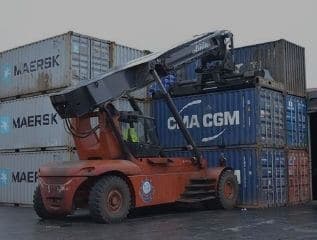
Breakbulk handling: bagged cargo, bulk, heavy lift and ro-ro
Containerisation has shaped maritime transport so thoroughly that it is easy to forget how much West African trade does not pass through the box. Bags of rice, bulk clinker, construction equipment, electrical transformers, steel coils: these cargoes travel differently and are handled differently.
This article describes the four main families of breakbulk handling and what each demands. The aim is not to train stevedores, but to let a shipper understand what determines whether a port call goes smoothly and where their own responsibilities lie.
The four families
- Bagged cargo
- Goods packed in bags: cereals, cement, fertiliser, sugar. Handling is repetitive and labour-intensive. The main issue is limiting breakage while maintaining output.
- Bulk
- Unpackaged goods, solid or liquid, handled by grab crane, suction or pumping. Output depends on the equipment available and the nature of the product.
- Ro-ro
- Vehicles and machinery that load and discharge under their own power or by towing, via a ramp. Handling is fast but manoeuvring requires qualified drivers and a traffic plan.
- Heavy lift
- Single pieces of high mass or out of gauge: transformers, steel structures, industrial equipment. Each piece is an operation in itself, with a lift plan, sling calculations and often dedicated inland transport.
What determines quayside output
A breakbulk vessel's port stay is not set by gang output alone. It results from a combination of factors, some of them entirely outside the port operator's control.
| Factor | Effect on the operation |
|---|---|
| Ship's gear | A vessel with its own cranes does not face the same constraints as one dependent on shore equipment. |
| Nature and packing | A 50 kg bag, a steel coil and a rolling machine call for neither the same gear nor the same rates. |
| Availability of inland resources | Without trucks or a shed ready to receive, the quay saturates and output falls, however good the gangs are. |
| Weather | Some cargo cannot be handled in the rain, which interrupts the operation. |
| Stowage plan | Poor stowage at origin forces rehandling and lengthens processing time. |
The most frequent bottleneck on a breakbulk call is not the ship, it is what happens downstream. A quay can only absorb so much cargo; if inland evacuation does not keep up, the operation slows mechanically.
Quay-to-shed transfer and the transit shed
Two terms recur constantly in breakbulk operations and deserve clarifying. Quay-to-shed transfer, known in French as extra-portage, is the movement of cargo from the berth to a shed inside the port estate. The transit shed is that immediate storage point, there to clear the quay during discharge.
This intermediate movement is not administrative complication: it determines how fast the vessel can be discharged. Without evacuation capacity towards a shed, the quay saturates and the call lengthens.
Also readStorage after the port passage then raises the question of customs status: bonded or non-bonded.Bonded or non-bonded warehouse: how to choosePrecautions by family
Bagged cargo
The breakage rate is the central indicator. It depends on packing quality at origin, on handling and on storage conditions. A shipper suffering recurring losses should examine their packaging before blaming the handling: a bag unsuited to humidity or stacking will break however good the gangs are.
Bulk
The issue is consistency between the quantity loaded and the quantity received. Weighing operations and joint surveys take on particular importance here, because on large tonnages the gap represents significant amounts.
Ro-ro
The main risk is not handling but the condition of the equipment. A condition report at loading and at discharge, with photographs, avoids arguments about the origin of a scratch or a dent. For machinery, keys, batteries and fuel must be settled upstream, or a vehicle that will not start immobilises the discharge.
Heavy lift
Each piece requires dedicated preparation: lift plan, identified lifting points, verification of available lifting capacity and, downstream, suitable transport. A low-bed or flatbed trailer cannot be improvised on the day of discharge. On these operations, coordination between ship, handling and inland transport must be settled well before the call.
For an out-of-gauge piece, the inland route must be validated before the vessel arrives: clearance of bridges and structures, movement permits, possible escort. A piece discharged without a validated route becomes an immediate storage problem.
What the shipper can do upstream
- Provide the real characteristics: unit weights, dimensions, lifting points, specific precautions.
- Check that packing withstands stacking, humidity and repeated handling.
- Announce the call early enough for inland resources and shed space to be reserved.
- Plan evacuation capacity downstream: without trucks and shed space, quayside output collapses.
- Organise joint surveys at loading and discharge, particularly for bulk and ro-ro.
Breakbulk handling is a coordination business before it is a muscle business. What separates a well-run call from one that bogs down rarely comes down to gang output: it comes down to synchronisation between ship, quay, shed and road.
- What is breakbulk handling?
- The handling of cargo that does not travel in containers: bagged goods, bulk, rolling equipment and heavy lift. It differs from container handling in the variety of equipment used and in the fact that each cargo type calls for its own organisation.
- What is quay-to-shed transfer?
- The movement of cargo from the berth to a shed inside the port estate, known as the transit shed. It clears the quay during discharge and directly determines the pace of the operation.
- Who is liable for damage found at discharge?
- It depends on when the damage occurred and on what the surveys establish. That is precisely why joint surveys at loading and discharge are decisive: without them, the origin of the damage cannot be demonstrated.
- How do you prepare the discharge of an out-of-gauge piece?
- By providing the exact characteristics of the piece upstream, validating the lift plan and lifting points, reserving suitable transport and checking the inland route, including any movement permits required.
Cargo to move?
Let's talk today.
Type of goods, origin, destination, volume: four details are enough for a first quote.